
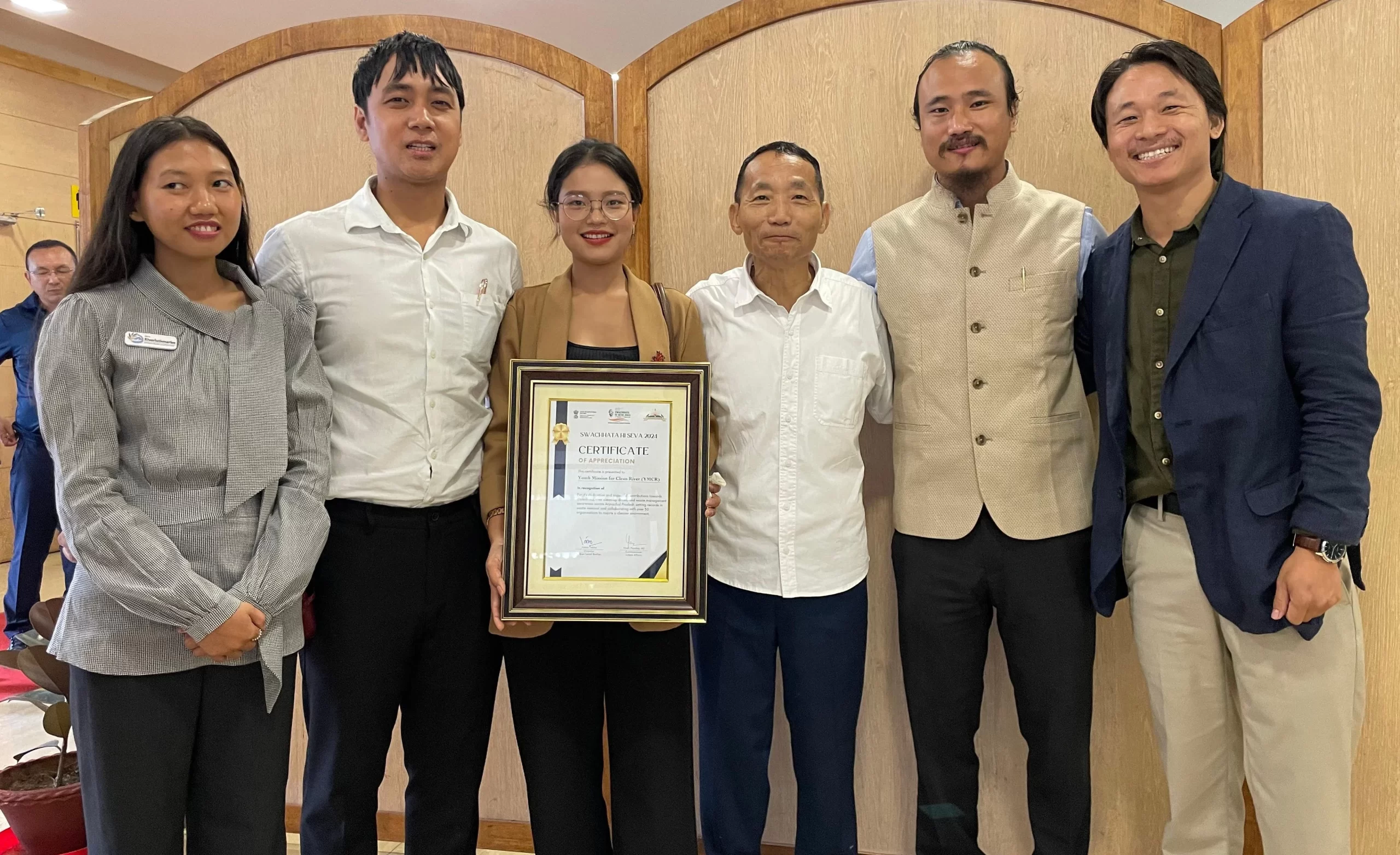
Itanagar: With over 70,000 kilograms of waste generated daily in Itanagar alone, Arunachal Pradesh’s capital region is buckling under the weight of its own garbage. Amidst mounting concerns over environmental degradation, a quiet revolution is gaining ground—led not by bureaucrats or corporations, but by a group of spirited young volunteers under the banner of Youth Mission for Clean River (YMCR).
What began as a modest cleanup drive in Itanagar’s Green Belt in 2016 has today evolved into a grassroots movement that’s not only removing garbage from riverbanks but also attempting to reshape public attitudes towards sustainability and ecological responsibility.

“We wanted to reconnect youth with nature—not just as observers, but as protectors,” said YMCR general secretary Dr Prem Taba during a recent interaction. “Rivers are our lifelines. Cleaning them is just the beginning.”
Despite operating without formal government funding or institutional MoUs, YMCR has emerged as one of Arunachal’s most committed environmental movements. It has relied on sheer volunteer strength and occasional logistical support from local bodies like the Department of Urban Development (DUDA), Public Works Department (PWD), Smart City Itanagar and the Itanagar Municipal Corporation (IMC).
So far, YMCR claims to have cleared over 1.1 million kilograms of waste from riverbanks and drainage systems across Itanagar, Naharlagun, Doimukh, and several other towns including Seppa, Palin, and Pasighat.
“This isn’t just about cleaning up. It’s about creating a long-term behavioural shift,” said another YMCR volunteer. “Our focus is not only on rivers but on the mindset that treats nature as disposable.”

The group follows a structured three-tiered waste management system. Waste collected is classified as wet, dry and recyclable. Biodegradable waste is composted near the riverbanks, while recyclables like plastic bottles and metal scraps are sold to local scrap dealers. Legacy waste is transported to the Hollongi dumping ground and non-biodegradable waste is eventually processed into Refuse-Derived Fuel (RDF) for industrial use.
YMCR also places strong emphasis on volunteer training, ensuring each cleanup is coupled with sessions on waste segregation, recycling and environmental ethics. However, keeping the momentum going has its challenges.
“We’ve tried everything—from awareness drives in schools to campaigns on social media—but sustained community engagement is still tough,” a representative admitted.
Plastic waste continues to dominate the pollution pile, particularly multilayered wrappers, PET bottles, and packaging material. YMCR has been actively promoting lifestyle changes such as using cloth bags, choosing unpackaged produce, and reducing household plastic consumption.
The situation is more complex in towns like Seppa, where untreated sewage flows directly into rivers, making cleanup efforts more difficult. In contrast, towns like Dirang have witnessed some success due to the presence of community-led waste segregation initiatives—a model YMCR hopes can be replicated across the Itanagar Capital Region.
YMCR also participates in regional efforts like The Himalayan Cleanup, a pan-Himalayan environmental campaign that spans 13 Indian states and neighboring countries.

“We realised during these events that waste segregation often takes longer than the cleanup itself,” said a volunteer, recalling the long hours spent sorting collected trash.
Beyond cleanup operations, YMCR is gradually expanding its efforts to include environmental education, green entrepreneurship and sustainable alternatives. The team is working towards developing recycling chains and exploring partnerships with government and CSR stakeholders to fund processing hubs.
Despite lacking official recognition or steady financial support, the team remains undeterred.
“If we lose our forests and hills, our rivers will follow,” said Taba who is also a member of Zero Waste Himalaya, the largest collective environmental action in the Indian Himalayas.
“We’re not just picking up trash—we’re trying to protect an entire ecosystem,” he added.
And in the absence of sweeping policies or grand government campaigns, YMCR’s relentless commitment serves as a reminder that sometimes, real change begins at the grassroots—with nothing more than a pair of gloves, a garbage bag and the will to act.
Also read: Encroachment creeps in as govt schools in ICR lie abandoned