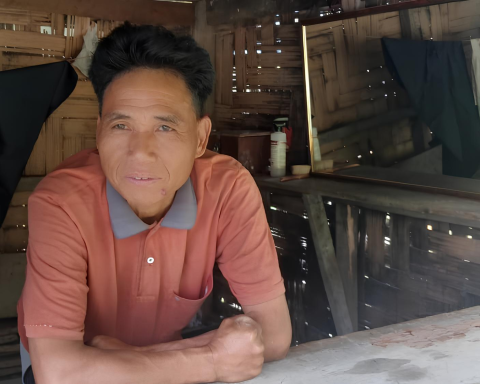


When Omak Komut sang, he did not merely perform. He remembered.
He carried in his voice the cadence of riverbanks and dormitory nights, the aftertaste of ritual chants and the elasticity of improvisation. His songs did not announce themselves as statements; they arrived like continuities — as though they had always existed, waiting only to be voiced again in a different time.
Komut passed away on December 18 at the Tomo Riba Institute of Health and Medical Sciences in Naharlagun. He had suffered a pressure stroke earlier and was undergoing treatment. He is survived by his wife, two daughters and a son. With his passing, Arunachal Pradesh has lost one of its most instinctive musical thinkers- a man who understood tradition not as a relic, but as something that moves, adapts and survives by listening.
From Rumgong village, Komut belonged to a generation that inherited its music orally, without notation or archive, learning instead through repetition, memory and community. Long before “folk” became a category or “fusion” a marketing term, he had already absorbed the tonal logic of abang and ponung- songs that do not merely entertain but carry genealogy, myth and moral instruction. These were not compositions in the modern sense; they were living texts, altered slightly each time they were sung, shaped by the singer and the moment.
In 1987, when Komut won a folk music festival in Hyderabad, it was not just a personal milestone. It was one of those rare moments when a voice from the margins briefly unsettled the centre, reminding a distant audience that the idea of Indian music had always been larger than its dominant traditions.
Yet it was in the years that followed- particularly after the formation of the Omak Komut Collective in 2006 -that his most consequential work began. The Collective did something that now seems obvious but then was quietly radical: it refused to treat tradition and modernity as opposites. Jazz, rock, funk, fusion and world rhythms did not overwhelm Adi folk music in their hands; instead, they bent themselves around it. The old songs did not disappear -they stretched.
The term “folk fusion” would later circulate widely, but for Komut and his collaborators, the idea was less about genre than survival. Younger listeners were already drifting toward global sounds. Rather than resisting that pull, Komut met it halfway, creating a musical space where ancestral voices could coexist with electric instruments and improvisation. In doing so, he ensured that tradition remained audible -not frozen in museums or ceremonies alone, but alive on stages, changing with the audience.
On stage, Komut was expansive, unguarded, almost playful. He sang in the Adi language, sometimes dancing, sometimes breaking into laughter, sometimes letting the music wander where it pleased. There was no rigid separation between performer and community; the boundary dissolved quickly. What audiences encountered was not nostalgia, but confidence -a sense that these songs belonged everywhere they were heard.
Away from the stage, Komut was also a priest of the Donyi Polo Ganging in Itanagar, a role that reflected the deeper coherence of his life. Music and belief were not parallel tracks for him; they were part of the same ethical universe. Both were ways of keeping relationships intact -between humans and nature, between the living and the remembered, between the present and what came before.
In recent years, as Arunachal Pradesh witnessed a renewed interest in indigenous languages and artistic forms, Komut’s work came to be seen as foundational. Many younger musicians found in his journey a permission of sorts -to look inward without embarrassment, to experiment without erasure. He showed that one could be contemporary without being detached from place.
His death leaves behind a silence that is difficult to describe. Not because the music has stopped -recordings and memories remain -but because a certain way of listening has gone with him. He understood when to hold a note and when to let it dissolve. He knew that not all traditions need guarding; some only need space.
In the end, what he offered was not preservation but continuity. And that may be his most enduring song.
Also read: Meet Taling Dupak, the barber who can’t hear or speak, but whose work tells a powerful story