

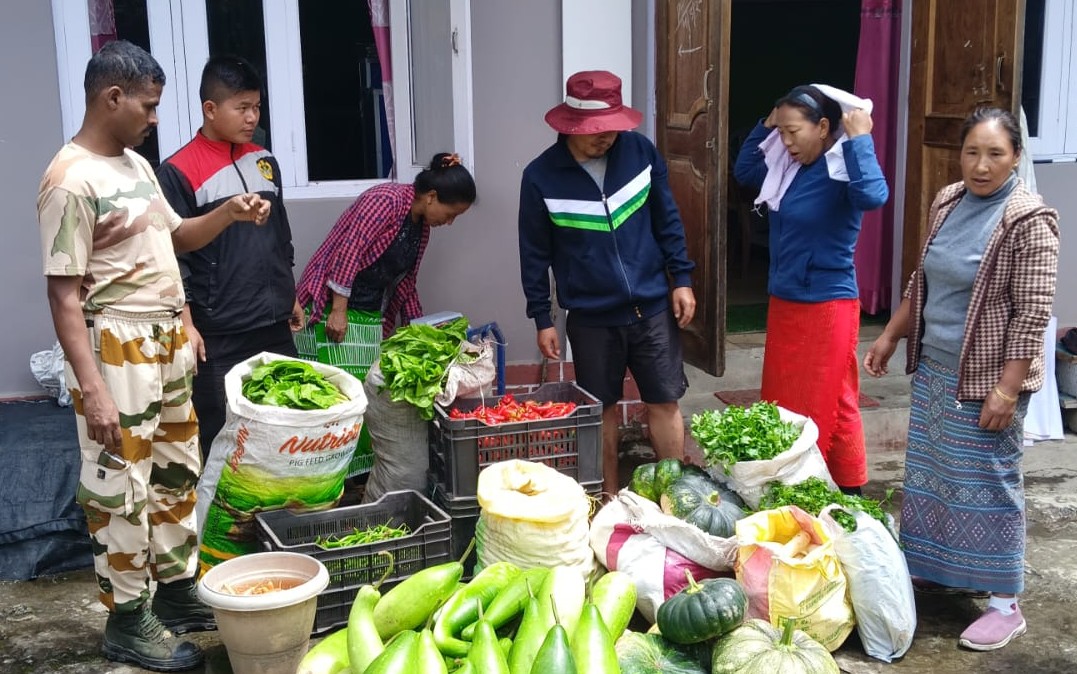
Tezu: As dawn breaks over Tezu’s bustling market yard, baskets of freshly harvested pineapples, bananas and pumpkins line up neatly. But these are not meant for local traders. Instead, they are headed for remote military posts perched high along Arunachal Pradesh’s rugged frontiers, signalling a quiet but transformative shift in the state’s agricultural economy.
This change is being driven by “Mission Arun Himveer“, an initiative connecting farmers in one of India’s most remote regions directly with institutional buyers such as the Indo Tibetan Border Police, redefining how agricultural markets function in the border state.

From isolation to opportunity
For decades, Arunachal’s farmers produced rich harvests but struggled to sell them in bulk. Fragmented markets, poor road connectivity and seasonal gluts often forced growers to accept distress prices or retreat into subsistence farming. The absence of dependable buyers meant uncertainty year after year.
Recognising this gap, the Arunachal Pradesh Agriculture Marketing Board (APAMB), under the leadership of its CEO Okit Palling, launched Mission Krishi Veer to create structured market linkages by enabling procurement of local produce by institutional buyers, including the Army.
A mission takes shape
As the model gained traction, it evolved into Mission Arun Himveer, a broader framework that institutionalised regular procurement of fruits, vegetables and other food items by security forces stationed across the state. What began as a pilot has now emerged as a policy model aligning rural prosperity with strategic needs.

At the heart of the mission is assured demand. APAMB coordinates procurement from self-help groups (SHGs), cooperatives and farmer producer organisations (FPOs), while a Rs 4-crore government-backed revolving fund ensures farmers receive timely payments as logistics are aligned with institutional requirements.
Formalising institutional demand
A major milestone came on November 29, 2024, when the state government signed a formal agreement with the ITBP to source fresh produce directly from local farmers. The agreement institutionalised a supply chain that was earlier informal and inconsistent.
Since then, the ITBP’s 9th Battalion has begun regular procurement from Tezu and neighbouring districts, bringing long-awaited stability to growers who once faced fluctuating prices and uncertain buyers.
Voices from the ground
Local leaders have welcomed the initiative for its economic and strategic value. Tezu-Sunpura MLA Dr Mohesh Chai described Mission Himveer as a “far-sighted” move that links farmers’ livelihoods with the nutritional needs of soldiers.
Former Lohit deputy commissioner KN Damo said the mission has achieved a long-envisioned goal, a direct bridge between farmers and institutional buyers. Farmer groups such as the Lohit Organic Farmers Producer Company Limited have termed the ITBP procurement “historic”, marking local farmers’ entry into organised markets.
ITBP commander Ashok Singh Bisht noted that the initiative serves dual objectives: providing fresh, nutritious food to personnel while creating dependable income streams for local producers.

Scaling impact across villages
Under the earlier Krishi Veer phase, farmers supplied nearly 197.5 metric tonnes of produce to Army depots in Tawang and Jang, earning over Rs 26 lakh. With the expansion under Himveer, more than 1,857 farmers from 189 designated Vibrant Villages have participated, while around 200 metric tonnes of food items valued at Rs 32 lakh have already been procured by the ITBP.
Beyond numbers
For many women-led SHGs, the mission has meant predictable incomes and reduced dependence on volatile open markets. By creating direct routes from farms to institutional kitchens, Himveer also addresses the logistical challenges of Arunachal’s terrain, reducing wastage and transport losses.
In a sensitive border state often cut off from mainstream markets, Mission Himveer is emerging as both an economic lifeline and a powerful symbol, giving renewed meaning to the slogan “Jai Jawan, Jai Kisan” in India’s easternmost frontiers.

Also read: Scoring at home in front of family was a dream come true: Omang Dodum
